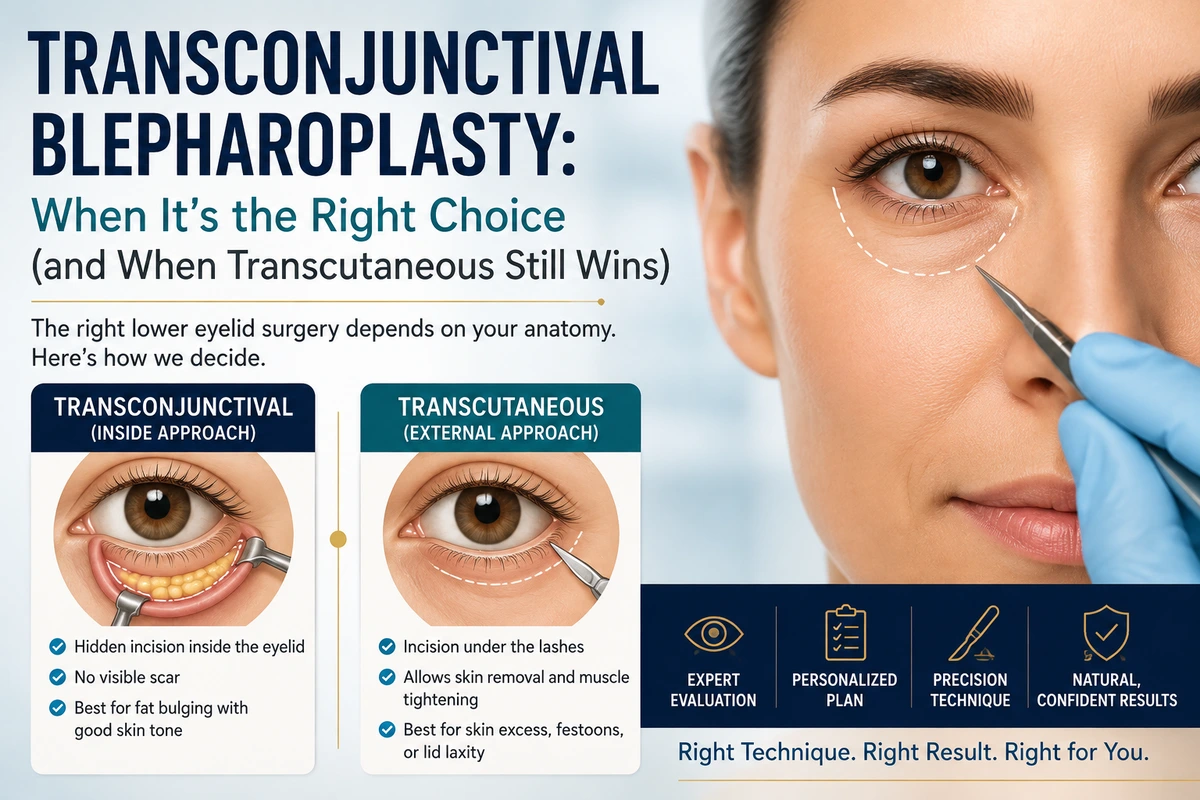
Transconjunctival blepharoplasty is a lower-eyelid surgery performed through a hidden incision inside the eyelid, leaving no external scar. It’s the right choice when a patient has bulging fat without excess skin, good eyelid tone, and no midface descent or retraction.
Good candidates are often younger people and / or those with East Asian, South Asian, and Southeast Asian type skin. Transcutaneous blepharoplasty — through an incision under the lashes — remains the correct choice when skin needs to be removed, festoons are present, the midface needs support, or significant eyelid laxity is present as may occur people with thyroid eye disease, chronic allergies, or floppy eyelid syndrome.
At PESA, we recommend a specific approach after examining eyelid tone, skin quality, fat distribution, and any prior surgery. One size does not fit every person or even eyelid.
Key Takeaways
- Transconjunctival blepharoplasty uses a hidden incision inside the eyelid and leaves no external scar — but it cannot remove excess skin, treat festoons, or repair lid retraction.
- Transcutaneous blepharoplasty uses a subciliary incision just under the lashes and remains the correct choice when skin excess, festoons, midface descent, or lid retraction are present.
- Fat transposition is the gold standard of lower eyelid blepharoplasty, regardless of which approach is used. Moving the bulging orbital fat down into the hollow beneath the eye is far superior to free fat grafts taken from other areas of the body for many reasons.
- Hybrid Techniques such as a transconjunctival, back of the eyelid, approach with a front of the eyelid, subciliary incision “skin pinch” removal of skin combines the risks and benefits of backside surgery with removal of just excess eyelid skin. Another approach is to combine a transconjunctival treatment with a skin LASER treatment to the front of the eyelid. Hybrid techniques are quite popular among surgeons, as they often carry a dual charge. But every procedure has its specific risks and benefits.
- Adding cantholysis to a transconjunctival approach not only allows many of the benefits afforded to a transcutaneous, subciliary approach as well as providing surgeons with more working room to potentially suture transposed fat directly to the orbital rim bone without additional external incisions or visible bolsters — but cantholysis and canthal reconstruction may permanently alter eye shape.
- Canthoplasty and canthopexy are different operations: canthoplasty rebuilds a fully cut lateral canthus, whereas canthopexy is an internal dissolvable stitch that eventually returns the eyelid to its natural shape. Both have different indications and benefits.
- Skin type matters. Patients with Asian or African American skin types that may scar, have pigmentary change, or keloid may do better with shorter skin incisions or transconjunctival approaches.
- PESA’s oculoplastic surgeons individualize care for each person, choosing the best approach based on eyelid tone, skin quality, fat distribution, patient goals, and prior surgery — not on any “house preference.”

Where Each Blepharoplasty Incision Sits
Where each blepharoplasty incision sits is one of the fundamental differences among lower eyelid blepharoplasty procedures.
The subciliary incision sits just below the lash line, running the length of the lower lid. It’s the classic transcutaneous approach of the original procedure and the more modernized variants. “Subciliary” isn’t a separate operation — it’s the incision that defines a transcutaneous lower blepharoplasty. Some surgeons list it as its own technique. It isn’t.
The transconjunctival incision sits on the inside of the eyelid, hidden against the eyeball. No external mark. Same operation family where the fat pockets are targeted, just a different starting point and limited treatment options.
The lateral canthal incision is small incision under 1 cm long — used with a canthopexy, canthoplasty, or the cantholysis release described above. It sits in the natural crease at the outer corner of the lower or upper eyelid and typically fades to appear as a natural smile line.
Transcutaneous: The External Approach
The incision runs just under the lash line, usually the full length of the eyelid. From that access, we can lift the skin, tighten the orbicularis muscle beneath, reposition or remove fat, elevate and resuspend descended midface, and re-drape the skin before closing with fine sutures.
Where It Wins
- Excess skin gets removed. Transconjunctival can’t do this.
- The orbicularis muscle can be tightened, which holds fat back, extends procedure longevity, and reduces recurrence. Transconjunctival does this weakly.
- Bulging fat can be sutured down beyond the orbital rim bone, cleanly and securely softening the hollow beneath the eye. Fat transfer with tranconjunctival can also occur, but it is less certain to be secure.
- Pre-existing lower-lid retraction, festoons (persistent swellings just under the eye), and midface descent can all be managed through the same incision.
Where It Costs
- The scar. Most incisions heal invisibly under the lashes. In patients with East or Southern Asian skin, the incision may leave a ridge or widen. In patients with African American skin, a dark line occasionally persists. These are real conversations to have before surgery, not after.
- The tarsoligamentous sling — the deep support structure that holds the lower lid against the eyeball (detailed anatomy in the StatPearls surgical reference) — can be weakened by dissection if not correctly performed. A weakened sling contributes to ectropion, the outward turning of the lid. Good techniques respect the sling. Sloppy techniques don’t.
- Sutures at the lash line persist until they dissolve, which may take several weeks.
We choose transcutaneous when the exam shows skin excess, festoons, midface descent, eyelid laxity or existing lid retraction. Those problems can’t be solved from the inside.
Transconjunctival: The Inside Approach
The incision sits on the inner surface of the eyelid — hidden from view. No external scar. No lash-line sutures. Fat is removed or repositioned, and the incision self-seals or gets one or two internal stitches.
Where It Wins
- Truly no visible scar. For a patient whose only issue is bulging fat and whose skin tone is good, this may be the best approach.
- The tarsoligamentous sling is more easily preserved. Ectropion risk drops.
- Incision recovery is faster — no external sutures to dissolve.
Where It Costs
- Scar tissue can form between the eyelid and eyeball, rarely causing double vision.
- Inward lid turning (entropion) can occur if internal scarring pulls the eyelid inward.
- Suturing fat down to the orbital rim bone is significantly harder from inside. To do it well, most surgeons either place two small skin incisions down at the level of the orbital rim, OR tie the fat-anchor sutures over cotton “bolsters” that sit on the cheek for one to two weeks. Bolsters are obvious on the face. Patients should know that going in.
- No skin removal is possible.
- No festoon management. No lid-retraction repair. If those problems exist and get ignored, the result can be disappointing.
We choose transconjunctival when appropriate: fat-only bulging, good skin tone, no festoons, no retraction. Then it’s a beautiful operation.
Transconjunctival with cantholysis can be performed. Cantholysis is a controlled release of the lateral canthus — the outer corner of the eye. Adding it to a transconjunctival approach opens the surgical field enough to suture fat directly to the orbital rim bone without external skin incisions and without bolsters. It also lets us tighten a mildly retracted lid at the same time.
The tradeoff is real. Releasing and reforming the lateral canthus can permanently change the shape of the eye — usually subtly, sometimes not. Some patients accept a small shape change for a scar-free, bolster-free result. Others don’t. It’s a conversation, not a checkbox.
We choose transconjunctival with cantholysis when the patient wants the internal approach, needs fat repositioned to bone, and has mild lower-lid laxity that would benefit from tightening anyway.
Canthoplasty vs. Canthopexy: Related but Not the Same
These terms frequently get confused. They’re different operations.
Canthoplasty is a reconstruction of a fully cut lateral canthus. It creates a real opportunity to tighten or elevate the lower lid — but it comes with more ocular-surface swelling, longer soreness during healing, the possibility of a permanent eye-shape change, and a small skin incision at the corner of the eye. A canthoplasty is used when the lid needs meaningful structural support, often in reconstructive or revision cases, or when the eyelid margin is very lax as may occur with thyroid eye disease, relative exophthalmos, or floppy eyelid syndrome.
Canthopexy is an internal, dissolvable stitch that gives the lid temporary support at the outer corner. No skin incision. Less swelling. The lid should return to its natural shape as the internal stitch dissolves. It’s used prophylactically — most often when we know the operation may destabilize the eyelid and want to reinforce it during healing.
Either can be added to either transcutaneous or transconjunctival blepharoplasty. Which one — or neither — depends on lid tone, laxity, and what the primary operation is going to disturb.
The approaches to lower eyelid blepharoplasty, at a glance. Each has a place. None is universally better for everyone.
| Approach | Incision | Best for | Main limit |
|---|---|---|---|
| Transcutaneous | External, under the lashes, full lid | Excess skin, festoons, midface descent, existing retraction, lax lower eyelids | Visible scar risk for specific skin types; risk for ectropion and eyelid retraction |
| Transconjunctival | Internal, between eyeball and back of lid | Fat bulging only, good skin tone, no retraction or eyelid laxity | Cannot remove skin, harder to suture fat to bone, double vision, entropion, cannot tighten muscle |
| Transconjunctival with cantholysis | Internal + outer-corner release | Transconjunctival indications with better fat repositioning, mild retraction correction | May permanently change eye shape, cannot remove skin |
| Canthopexy or canthoplasty (adjunct) | Outer corner only, paired with either approach above | Lid tightening or elevation support | Different tradeoffs — see below |
| Skin Pinch | Subciliary incision with skin removal | Addition to transconjunctival approach or in isolation if skin laxity only is the issue | Sometimes a double charge when combined with transconjunctival surgery, no ability to tighten eyelid muscle, lid laxity, or midface descent |
| LASER treatment | No incision | Addition to transconjunctival approach or in isolation if skin laxity only is the issue | Prolonged healing if effect goes beyond several weeks of swelling. Possible pigment change, dark early, and pale later. |
Some surgeons use the same approach for all patients as it is most comfortable for them. However, the most appropriate treatment is not the one the surgeon happens to prefer but instead is determined by the patient’s fundamental anatomy and goals.
How We Choose at PESA
The exam decides, not a marketing brochure or internet posting. Here’s the selection logic we work through, roughly in order:
- Is there real skin excess? If yes → transcutaneous. Transconjunctival can’t fix it.
- Festoons present? If yes → transcutaneous. Sometimes with adjunct midface support.
- Is the midface descending? If yes → transcutaneous, often paired with midface lifting.
- Existing lower-lid retraction, ectropion or lax eyelid? If yes → transcutaneous, or transconjunctival with cantholysis when the retraction is mild and the patient wants minimal external scar.
- Only fat bulging — good skin tone, no retraction, no festoons? If yes → transconjunctival is the elegant answer. Cantholysis is added if we need to anchor fat to bone.
- Skin-type considerations. Patients with East or South Asian skin, African American skin, or a personal history of hypertrophic scarring get a longer conversation about the transcutaneous scar. Sometimes we choose a transconjunctival approach and sacrifice the ability to perform other tightening and elevating procedures.
- Revision cases. Prior surgery changes the map. Scar tissue, existing retraction, or lash-line loss can push us either direction. This is where experience is essential.
The bottom line: choose the approach that matches the anatomy, not the one that markets best.
Frequently Asked Questions
Is transconjunctival blepharoplasty safer?
It carries a lower risk of ectropion because the supporting structures of the lower eyelid are disturbed less. But it introduces different risks, including internal scarring, entropion, and difficulty securing fat to the orbital rim. “Safer” depends on the anatomy being treated.
Does transconjunctival blepharoplasty leave a scar?
No external scar. The incision is inside the eyelid. Internal healing still occurs, but nothing is visible on the skin.
Can transconjunctival surgery remove loose skin?
No. Excess skin requires a transcutaneous incision, a skin pinch, or another skin-tightening procedure.
Can transconjunctival surgery treat festoons?
No. Festoons involve skin, muscle, and deeper supporting tissues that cannot be adequately addressed through an internal incision alone.
Why do some surgeons tie sutures over bolsters?
When fat is repositioned from a transconjunctival approach, many surgeons secure the sutures externally over small cotton bolsters on the cheek to hold the fat while healing occurs. The bolsters stay in place for about one to two weeks before removal.
Can transconjunctival surgery change eye shape?
Not by itself. However, adding a cantholysis or canthoplasty to improve access or tighten the eyelid may subtly or permanently change the eye shape. This possibility should be discussed before surgery.
How do I know which approach I need?
An examination of your eyelid anatomy determines the answer. Skin quality, lid tone, fat position, previous surgery, and your goals all matter. There is no universally best technique.
Schedule a Lower Eyelid Evaluation
If you’re considering lower eyelid surgery, the first step is determining which approach actually fits your anatomy. Dr. Charles Soparkar and the surgeons at Plastic Eye Surgery Associates evaluate skin quality, fat distribution, eyelid support, and facial structure before recommending either transconjunctival or transcutaneous blepharoplasty. Schedule a consultation to learn which option is most appropriate for you.