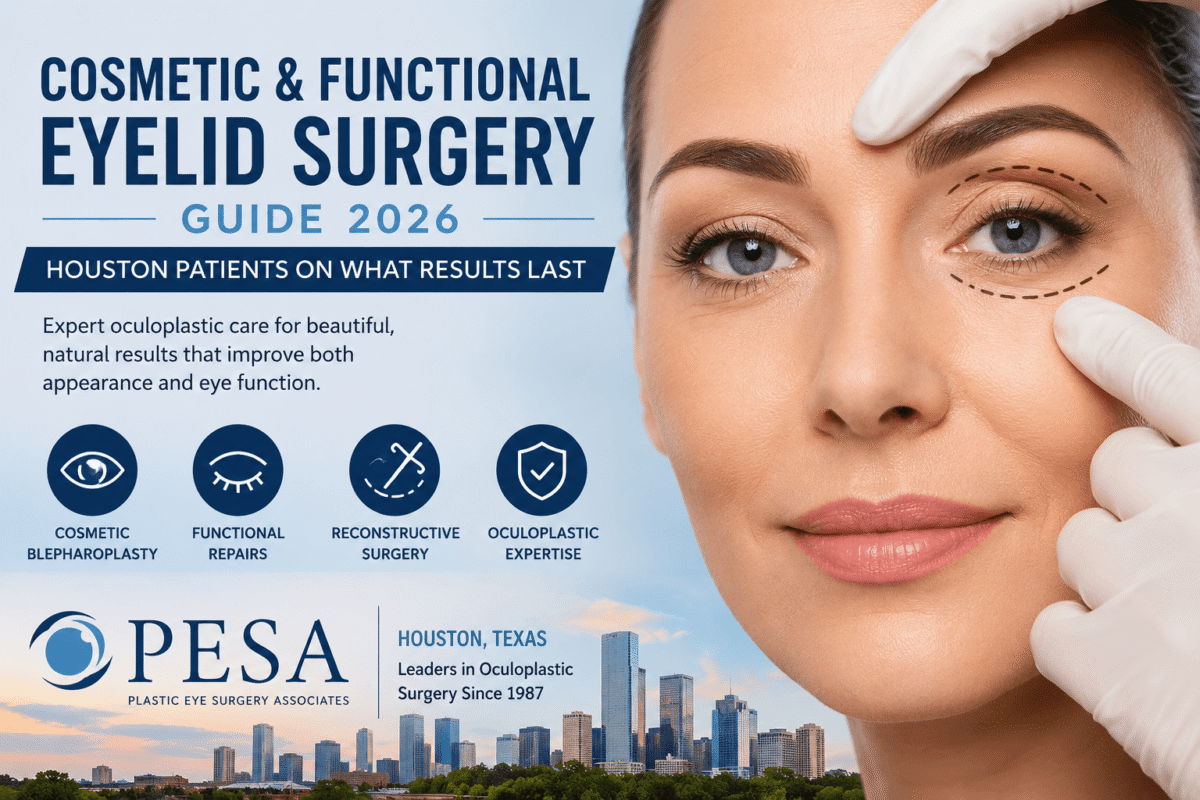
Eyelid surgery in Houston is one of the most commonly performed procedures at Plastic Eye Surgery Associates — and one of the most misunderstood. Patients arrive having seen three different types of surgeons, received three different recommendations, and still don’t know what they actually need. This guide covers what eyelid surgery involves, who performs it, how functional and cosmetic procedures differ, and what recovery looks like when the surgery is done correctly.
Key Takeaways
- PESA performs more than 1,000 eyelid surgeries per year — one of the highest volumes of any practice in the United States, cosmetic and reconstructive combined.
- Eyelid surgery splits into two distinct categories. Cosmetic blepharoplasty improves appearance. Functional procedures — ptosis repair, entropion, ectropion — are medically necessary and often covered by insurance.
- The surgeon’s training determines the outcome. Oculoplastic surgeons complete ophthalmology residency before the fellowship — meaning they understand the eye’s mechanics, not just the eyelid’s appearance.
- Most PESA eyelid procedures happen in the office. No hospital or surgery center facility fee. Local anesthesia with optional IV sedation. Patients go home the same day.
What Eyelid Surgery Covers — and Why Surgeon Selection Matters More Than Most Patients Realize
“Eyelid surgery” isn’t one procedure. It’s a category — cosmetic, functional, reconstructive — performed by surgeons with widely different training backgrounds. The American Academy of Ophthalmology recommends oculoplastic surgeons for eyelid procedures specifically because of the combined training in ophthalmology and plastic surgery. General plastic surgeons don’t train at the same scale around the eye. The difference isn’t theoretical — it shows in outcomes and eye safety.
This guide is for patients weighing their options: cosmetic vs. functional, upper vs. lower, surgical vs. non-surgical. It covers the procedures PESA performs, how to know which one applies to your situation, what recovery involves, and what results actually last.
Cosmetic Eyelid Surgery: Upper, Lower, and Combined Blepharoplasty
Blepharoplasty is the surgical removal of excess skin, fat, and tissue from the upper eyelid, the lower eyelid, or both. It’s one of the most frequently performed cosmetic procedures in the United States — and one of the most frequently over-corrected.
At PESA, the philosophy is conservative. Anatomy-driven. The goal isn’t a dramatic transformation — it’s restoring what time and genetics have altered. Patients should look rested and gently refreshed. Not different.
Upper Eyelid Surgery
Upper eyelid surgery removes the excess skin and tissue that descends over the upper lid with age. That tissue makes the eyes look heavy, tired, or half-closed — not because the patient is tired, but because the lid has changed. When it obstructs the visual field, the procedure may qualify for insurance coverage as a functional repair rather than cosmetic blepharoplasty. The distinction matters for billing — and for how the surgery is approached.
Incisions are placed inside the natural lid crease. Once healed, they’re typically and virtually invisible.
Lower Eyelid Surgery
Lower eyelid lift surgery addresses under-eye bags, puffiness, dark crescents, and sagging skin below the eye. The approach varies significantly by patient anatomy:
- Transconjunctival blepharoplasty — incision inside the lower lid, no external scar
- External approach with skin excision — for patients with significant excess skin
- Fat repositioning — moves rather than removes the orbital fat, reducing the hollow under-eye appearance
- Canthoplasty — tightens and elevates the outer eyelid corner when laxity is present
The appropriate technique depends on each person’s anatomy and goals, not a standard protocol. At PESA, the approach is determined at consultation after a detailed examination — not before it. One procedure or approach does not “fit all”.
Combined Upper and Lower Blepharoplasty
Both procedures can be performed together in a single session. Most patients who need lower eyelid work also have upper lid changes — doing both at once avoids a second recovery period and produces a more balanced result. PESA performs more than 1,000 combined blepharoplasties annually.
How Long Do Results Last?
A decade or more for most patients. Aging continues — but from a better baseline. You’ll always look younger, be more “cleaned up” than you would have without surgery. Sun exposure, smoking, diet, and genetics influence how quickly changes resume. In that sense, the improvement itself is permanent.
Functional Eyelid Surgery: When the Eye Needs It, Not Just the Appearance
Not all eyelid surgery is cosmetic. Several conditions affecting the eyelid’s position, mechanics, or structure require surgical correction — not for appearance, but because eye health and vision depend on functioning eyelids.
Ptosis Repair
Ptosis repair corrects a drooping upper eyelid caused by weakened impact of the levator muscle — the muscle responsible for lifting the lid. When the lid drops far enough to obstruct the visual field, the procedure is medically necessary. Insurance typically covers it when properly documented with visual field testing.
Cosmetic ptosis correction addresses a lid that’s descended enough to look asymmetrical or fatigued without obstructing vision. The techniques overlap significantly — the clinical distinction is in the degree of droop, the documentation and billing, not always the surgery itself.
Entropion and Ectropion Repair
Entropion is turning of the eyelid inward — lashes against the cornea, chronic irritation, surface damage. Ectropion is turning of the eyelid outward — the lid pulls away from the eye, causing tearing, exposure, and ocular surface dryness. Neither resolves with eye drops or artificial tears. Both require surgical correction to restore normal lid position and eye protection.
Eyelid Reconstruction After Cancer or Trauma
Eyelid reconstruction is required when cancer removal, trauma, or prior surgery complications have altered the eyelid’s structure. Mohs reconstruction — rebuilding the lid after micrographic skin cancer surgery — is among the most technically complex procedures in the oculoplastic field. Precise tissue transfer is fundamental. The goal is restoring both form and function. Not every oculoplastic surgeon performs high volumes of this. PESA does.
How Eyelid Surgery Differs From What a General Plastic Surgeon Offers
The American Society of Plastic Surgeons lists blepharoplasty among the most commonly performed cosmetic procedures in the country — and most of those are performed by general plastic surgeons. That’s not inherently wrong. But it matters in specific circumstances.
Oculoplastic surgeons complete full ophthalmology residency before their fellowship — years of microsurgical training at submillimeter scale that general surgery residency doesn’t include. Sutures used in ophthalmology are orders of magnitude finer than those used in general surgery. When a complication arises near the eye, or when a functional condition like ptosis or entropion needs correction, that training gap becomes clinically relevant.
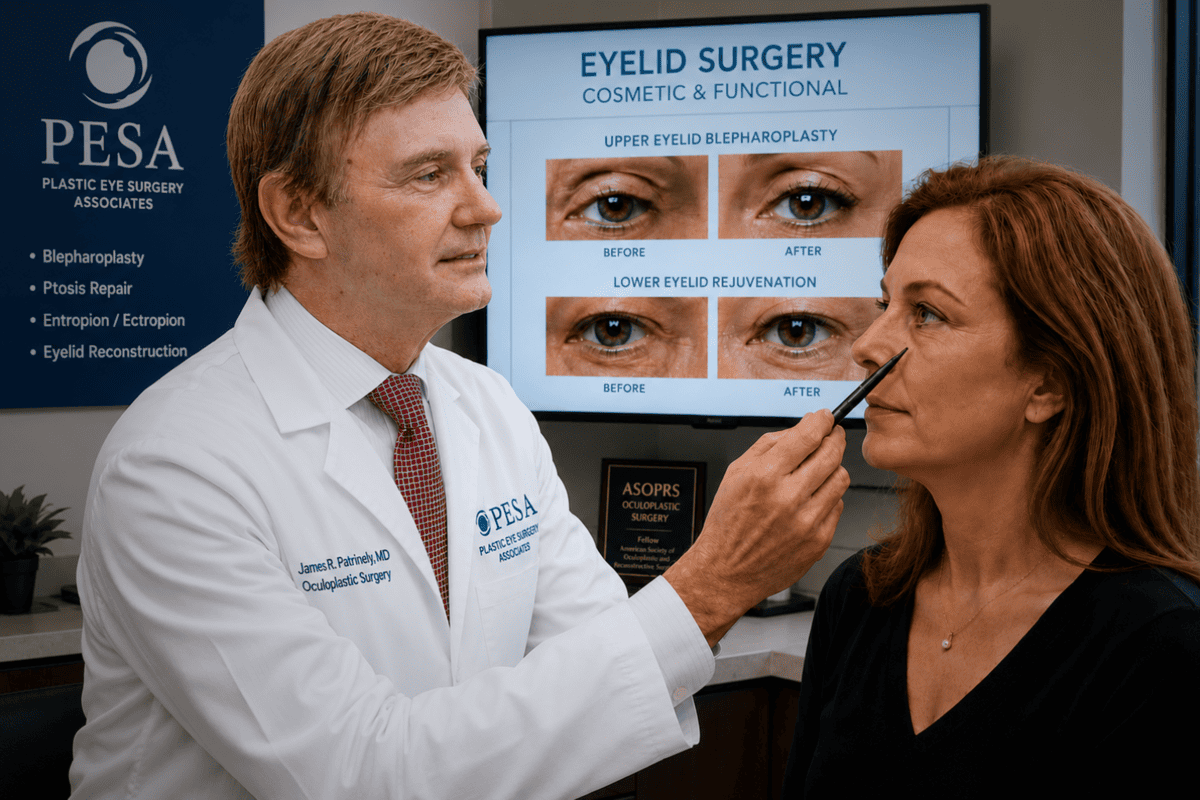
Both Dr. James R. Patrinely and Dr. Charles N.S. Soparkar at PESA hold ASOPRS credentials — the American Society of Ophthalmic Plastic and Reconstructive Surgery, the gold standard in oculoplastic credentialing. Fewer than 600 surgeons in North America qualify. Both trained at Baylor College of Medicine and completed fellowships at Johns Hopkins Medical Center, Harvard & Massachusetts Eye and Ear Infirmary, and M.D. Anderson Cancer Center.
What to Expect: Recovery From Eyelid Surgery at PESA
Most patients return to social activities within seven to ten days. Bruising and swelling are normal in the first one to two weeks — this isn’t a sign something went wrong, it’s the expected healing response. Full results, including complete scar maturation, take three to six months.
What makes PESA’s recovery process different from a hospital or surgery center-based practice:
- Most procedures happen in the office — no hospital facility fee
- Local anesthesia is standard; IV sedation by a board-certified anesthesiologist is available, but not essential
- Patients go home within half an hour after surgery completion
- Infection rates following hospital procedures are much higher
- General anesthesia is reserved for the most complex orbital cases only
Preparation matters. Blood thinners, aspirin, and NSAIDs must typically be paused before surgery. Bring a complete medication list to your consultation. The more complete your history, the fewer surprises during recovery.
Eyelid Surgery in Houston: Why Patients Choose PESA
PESA’s primary office sits at 3730 Kirby Drive, Suite 900 — within the Texas Medical Center corridor, the largest medical complex in the world. A second office in The Woodlands serves the north Houston area. A third location in Pensacola, FL serves the Gulf Coast.
But geography isn’t why patients travel from Dallas, San Antonio, out of state and from around the world. They come for two things: subspecialty depth and the experience that comes from procedure volume. PESA performs more than 1,000 blepharoplasties per year. Complex revision cases — patients who experienced complications with other surgeons — are a significant part of the practice. Lagophthalmos, lid retraction, over-resection, asymmetry. These cases require the kind of training and volume that most practices, oculoplastic or otherwise, can’t offer.
No facility fee for office procedures. Same-day recovery. Insurance eligibility reviewed at consultation and before surgery for any procedure that may qualify as functional.
How to Prepare for Your Eyelid Surgery Consultation at PESA
Know What You’re Trying to Correct
Cosmetic concern or functional problem? Both? The answer affects which procedure applies, whether insurance coverage is possible, and which surgeon’s subspecialty experience is the closest match. Don’t arrive with a procedure in mind — arrive with the problem you want solved. The examination determines the recommendation.
Bring Your Medication List
Blood thinners, aspirin, NSAIDs, GLP-1 receptor agonists — these must typically be paused before surgery, often 10–14 days in advance. Bring a complete list of everything you’re taking, including supplements. Some — like fish oil and vitamin E — also affect bleeding. Better to review them at consultation than discover the issue the week before surgery.
Ask About Insurance Early
Ptosis repair, entropion and ectropion correction, and eyelid reconstruction are typically covered by insurance when medically necessary and properly documented — including visual field testing where applicable. PESA reviews eligibility at consultation. Don’t assume coverage or rule it out before you know.
Plan Your Recovery Window
Seven to ten days before you’re comfortable in social settings. Two weeks before most swelling is manageable. Three to six months before you see the final result. Plan surgery around your calendar — not the other way around.
Frequently Asked Questions About Eyelid Surgery
How much does eyelid surgery cost in Houston?
Cost depends on whether the procedure is cosmetic or functional, whether one or both eyelids are treated, and whether additional procedures such as ptosis repair or canthoplasty are required. Functional procedures may qualify for insurance coverage. The exact cost is provided after examination and treatment planning.
Does insurance cover eyelid surgery?
Insurance may cover procedures that are medically necessary, including ptosis repair, entropion and ectropion repair, and certain reconstructive surgeries. Cosmetic blepharoplasty is generally not covered. PESA evaluates eligibility during consultation.
How long does eyelid surgery take?
Most eyelid procedures take between 45 minutes and two hours, depending on complexity and whether multiple procedures are performed at the same time.
Will there be visible scars?
Incisions are placed in natural eyelid creases or inside the eyelid whenever possible. Once healed, scars are typically difficult to detect.
How painful is recovery?
Most patients describe recovery as uncomfortable rather than painful. Swelling, bruising, and temporary tightness are expected. Significant pain is uncommon and should be reported to your surgeon.
How long do eyelid surgery results last?
Most patients enjoy results for ten years or longer. Aging continues, but surgery resets the baseline. Patients generally continue to look younger than they would have without treatment.
Schedule an Eyelid Surgery Consultation in Houston
Whether you’re considering cosmetic blepharoplasty, functional eyelid surgery, or reconstruction after trauma or skin cancer treatment, the first step is a comprehensive examination with an experienced oculoplastic surgeon.
Plastic Eye Surgery Associates has performed thousands of eyelid procedures for patients throughout Houston, The Woodlands, Texas, and beyond. The practice combines fellowship-trained expertise, high surgical volume, and office-based convenience to deliver both cosmetic and functional eyelid care.
To learn more about your options, schedule a consultation with PESA.
Plastic Eye Surgery Associates
3730 Kirby Drive, Suite 900
Houston, TX 77098
(713) 795-0705